


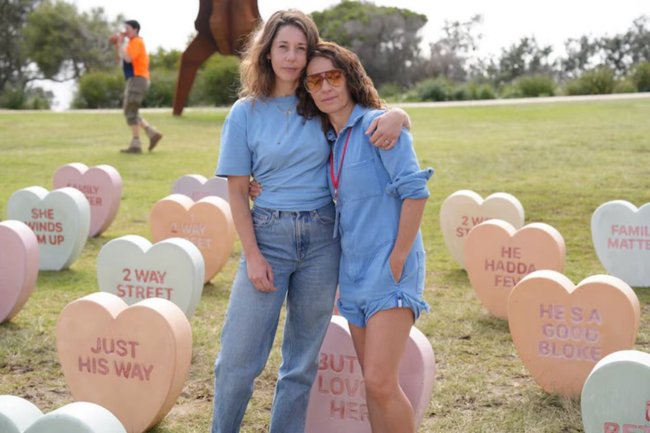
Sixty concrete hearts have been erected across Sydney beaches.
From a distance, the art installation creates a sea of happy colours but a closer look reveals inscribed words meant to spark an important conversation about violence against women.
Long-time friends Philippa Lysaght and Omi McCurdie are the women behind the installation, which features as part of the iconic Sculptures By The Sea art event.
Know the news with the 7NEWS app: Download today
The 60 hand-polished concrete hearts, entitled Sweethearts, stand at Marks Park between Sydney’s Bondi and Tamarama beaches.
Each heart is meant to represent a woman who has been killed by violence this year.

Lysaght’s background is in advocacy work and she has always wanted to do something in the women’s rights and violence against women space.
“I’d actually been working overseas with the UN for quite a long time, in and out of conflict zones and humanitarian emergencies,” Lysaght told 7NEWS.com.au.
“And then coming back to Australia in 2020 during COVID, like so many of us did, I was just really shocked that in a country like ours, that has the resources to really pour into prevention and response, the state of violence against women was just so dire.
“It really struck me as something’s not right here.”

Australian charity White Ribbon defines violence against women as any act of gender-based violence that results in, or is likely to result in, physical, sexual or psychological harm or suffering to women, including threats of such acts, coercion or arbitrary deprivations of liberty, whether occurring in public or private life.

Despite there being so many incredible organisations working in the sector doing research, advocacy and prevention, Lysaght said it was “pretty scary” that women were still dying at the hands of violence.
She consulted with several community groups and women’s shelters to come up with the phrases etched into each heart that typically “excuse, minimise or ignore violence”.
“It was tough to get it right,” Lysaght said.
“The whole artwork really lived or died on whether those phrases were something that would feel gut-wrenchingly familiar.
“We could have just written a whole bunch ourselves and chosen them, but we actually did a series of workshops.”
The chosen phrases, which include “Asked for it”, “Boys will be boys” and “She coulda left”, fall into four broader categories of how people react when they witness violence against women: ignore, minimise, excuse and shift blame.
“We really wanted this to be relatable and we also wanted it to be really Aussie,” Lysaght said.
“The installation being at Sculptures By The Sea is such a good opportunity to draw attention to this as a national emergency.”

Sculpture artist McCurdie was responsible for the technical design of the hearts and explained the reasoning behind using the heart-shaped iconic lollies as inspiration.
“Using the lolly makes it accessible for everyone,” McCurdie told 7NEWS.com.au.
“I think however old you are from, five or 50, you’re going to know what that sweet is. It was also instrumental in us getting people to engage with the work because from afar it looks really sweet, colourful and playful.
“And it’s not until you start approaching the work do you actually start reading the sayings and seeing what the work is about.”
McCurdie said she was happy to see people of all ages engaging in their installation.
“I’m sure a lot of it will go over children’s head, but I think it’s good for them to start asking what it means and to have these conversations about violence and women early: what actually happens in our society and how we can try to prevent that?”
The hearts are made from concrete, which McCurdie said also helps them resemble tombstones.

“We wanted the 60 hearts to reflect gravestones, as a memorial, as it represents the lives of 60 Australian women who have been killed by violence,” Lysaght said.
For the women, the point of the installation is to “influence the perpetrator” and to encourage people to step in and speak up when they hear people using the phrases written on the hearts.
“The whole purpose for me has been about targeting the friends of the perpetrator to call him out and to not excuse violence,” Lysaght said.
“We have this culture in Australia of silencing abuse by ignoring it or minimising what’s happening, or excusing him, or you know even more horrifically shifting the blame onto her by saying things like, ‘She could have left’ or ‘She winds him up’.
“The installation lets everyone recognise that these little phrases that we say, that are seemingly harmlesss, are actually breeding a broader culture of tolerance of violence.
“But that’s not acceptable and we are not powerless in this.”


