


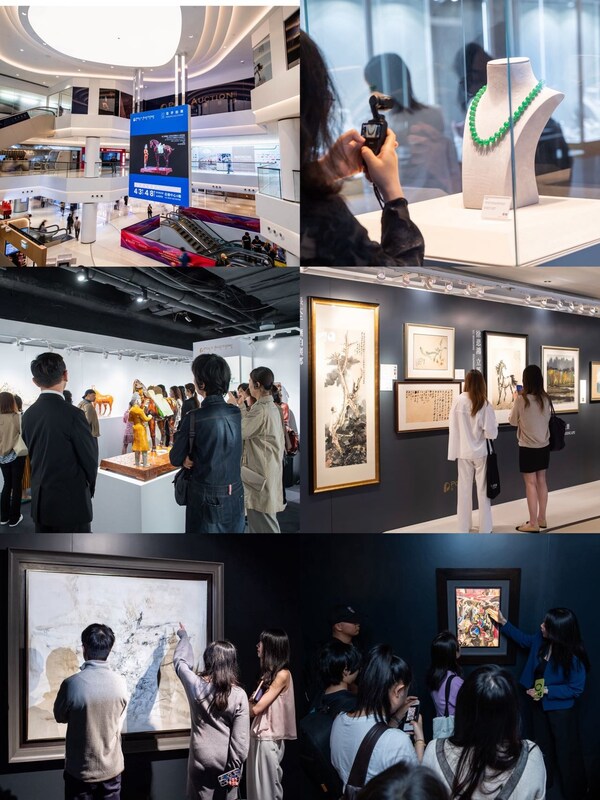
Live Auctions: 6 – 8 April
4/F, Shun Tak Centre
HONG KONG, April 6, 2026 /PRNewswire/ — This spring, Hong Kong’s auction scene once again welcomes a major art event. Poly Auction Hong Kong proudly presents the Auction Preview and Live Auctions, with the Preview and Auctions taking place grandly on 4th floor of Shun Tak Centre from 3 to 8 April. At 11:00 a.m. on 6 April, the High Jewelry and Watches auction will be the first to go under the hammer, followed at 3:30 p.m. that same afternoon by the Modern and Contemporary Art auction. The auctions of the Chinese Ceramics and Works of Art Department and the Chinese Painting and Calligraphy session will then take place successively at 10:30 a.m. on 7 April and 11:00 a.m. on 8 April, respectively.
This season’s Spring Auctions bring together four major categories: Modern and Contemporary Art, Chinese Ceramics and Works of Art, Chinese Paintings and Calligraphy, and Jewels and Watches, featuring a distinguished selection of major lots with both important art-historical research value and strong market attention. Masterpieces including Liu Wei’s You Like Pork?, a Blue and White ‘Grapes’ Foliate-Rim Dish Yongle Period, Xu Beihong’s Standing Horse, the “Emerald Radiance” Jadeite bead, Ruby and Diamond Necklace, and Patek Philippe Nautilus Ref. 5980/1A-001 will make their debut in Hong Kong, promising an extraordinary auction event not to be missed.

Modern and Contemporary Art
The Modern and Contemporary Art Department has handpicked works by pioneers of 20th-century Oriental aesthetics and preeminent representatives of Chinese contemporary art for this spring’s auction, alongside cutting-edge explorations from the international art scene. The selection delineates an artistic lineage that bridges China and the West, and connects the ancient and the modern, from a diverse and inclusive perspective.
This auction features LIU WEI’s You Like Pork?, created in 1995 during a critical transitional period in the artist’s style. Exhibited in the same year at the Venice Biennale’s centennial special exhibition, the work belongs to a series of only six paintings and is the sole example currently in circulation. This monumental 200 × 155 cm. canvas constructs a wasteland of desire, accurately prophesying the arrival of a consumer era. You Like Pork? reveals the artist’s inward turn from political symbols towards an exploration of the essential nature of human society, marking a rare and pivotal shift in Chinese contemporary art of the 1990s. Transcending direct responses to specific political contexts, it refines a “cynical” and “bohemian” mode of existence into an aesthetic language charged with both universal philosophical resonance and powerful sensory force.
Also commanding great attention is ZAO WOU-KI’s 15.07.67. Painted in the mid-1960s—a pivotal and highly acclaimed period in the artist’s career—this work represents a fundamental stylistic shift for ZAO WOU-KI, from his early calligraphic symbol-based language to a more expansive abstract structure. The canvas is layered with extremely thin, translucent oil glazes, with a concentrated dark core emerging from a misty, pale background, endowing the painting with a fluid, breathing quality reminiscent of Chinese ink wash art. ZAO WOU-KI masterfully translates the intangible presence of clouds and waters between heaven and earth in Mi Fu’s Song dynasty landscape paintings into the abstract fluidity of modern oil paint. Among his creations of the 1960s, ZAO WOU-KI’s “White period” compositions are exceptionally rare. This piece stands as the culmination of his integration of the Eastern ink wash philosophy of negative space and Western abstract expressionist language and can be regarded as a perfect embodiment of Song dynasty landscape aesthetics in the contemporary abstract spirit.
In WU DAYU’s Rhymes of Beijing Opera, the artist distils the vibrant atmosphere, shifting light and shadow, and dynamic figure movements of the Beijing Opera stage into pure abstract rhythm. The composition features a complex yet compact structure; he intentionally articulates the pictorial plane through brushwork running in different directions and blocks of colour to construct multiple spatial layers, creating a rich and powerful visual symphony. With overlapping thick washes of red and blue as the base, and crisp white oil lines for outlining, he adopts the brush techniques of pressing, lifting, turning and hooking strokes from Chinese calligraphy, deconstructing physical forms into twisting, rhythmic cadences. The entire work serves as the ultimate testament to his supreme pursuit in painting: “Colours flow, forms leap”.
If Paul Cézanne’s Mont Sainte-Victoire is the sacred peak of Western modern art, WU GUANZHONG’s The Qianling Mountains can be deemed a towering pinnacle of Sino-Western artistic integration in the history of modern Chinese art. Painted in the 1970s, this work is a pivotal work by the artist. He builds the mountain forms with heavy, impasto brushstrokes, transforming the natural landscape into a composition of formal order through the structural combination of straight and curved lines. Breaking away from realistic colour rendering, he prioritizes rhythmic balance, with green and grey as the dominant hues interspersed with shades of blue, yellow and red, and employs the texture of oil paint to evoke the green, rugged character of mountain ridges. More than a depiction of the mountain scenery in Guiyang, this work integrates the spiritual essence of Song dynasty landscape painting, the formal freedom of Shi Tao, and the modern artistic concepts pioneered by Cézanne. It embodies WU GUANZHONG’s unique artistic language that fuses Chinese and Western elements, and stands as a significant milestone in the history of modern Chinese art.
Also exploring modern artistic vocabulary within the vein of Sino-Western integration, this auction presents Watermelon, a pastel work executed in 1960 by LI CHAOSHI, a pioneer of modern Western-style painting in China. Produced at the end of the Three Years of Economic Hardship, the work uses the image of plump, solid watermelons as a metaphor for abundance and vitality. The cut watermelon wedges in the painting are rendered with dense, short touches of colour to create a robust framework, revealing a Cézanne-like sense of structure and form; the whole watermelon in the background is outlined with concise, sweeping curves, and the pastel techniques taught by Edgar Degas are fully absorbed into the artist’s simple yet solid personal visual language. Defying the traditional perception of pastels as delicate and lightweight, LI CHAOSHI endows the work with a volumetric quality akin to oil painting and a sculptural texture through repeated layering and pressing, elevating pastels to a modern medium capable of expressing structural order and light and shadow dynamics. With a full, cohesive composition, the blue-toned shadows form a gentle contrast with the red and green watermelon forms, showcasing both the artist’s Western training in light and shadow and the Chinese literati’s affection for the inherent charm of objects, thus highlighting his unique position in pastel creation in the history of Chinese art.
Chinese Ceramics and Works of Art
Poly Auction Hong Kong Spring Auctions 2026 will soon open, and the Chinese Ceramics and Works of Art Department presents three carefully curated sales: Peak of Grandeur: A Fine Selection of Important Imperial Treasures, The Way of Things: Treasures of Early Chinese Art, and Chinese Ceramics and Works of Art. Through rigorous academic curation and clear thematic planning, the auction brings together a series of art treasures with well-documented provenance and exquisite craftsmanship. A total of over 500 lots will be offered across the three special sessions this season, including museum-calibre masterpieces and fine art curios suitable for both new and seasoned collectors. It fully showcases the artistic craftsmanship and historical heritage of Chinese civilization spanning thousands of years, providing diverse and professional collection options for domestic and international collectors with varying collecting needs.
The three sales each have their own focus and complement one another, forming a coherent collecting framework for Chinese works of art. Peak of Grandeur: A Fine Selection of Important Imperial Treasures focuses on imperial kiln porcelain of the Ming and Qing dynasties, important decorative artifacts, ritual vessels and scholar’s stationery crafted by the Imperial Workshop. It features carefully selected imperial art treasures with clear provenance and unbroken inheritance, recapturing the pinnacle craftsmanship and the prosperous aura of royal aesthetic taste. The Way of Things: Treasures of Early Chinese Art is themed “Following the Way of Objects, Witnessing the Vein of Civilization”, encompassing jade artifacts of the Liangzhu Culture of the Neolithic Age, bronze ritual vessels of the Shang and Zhou dynasties, pottery sculptures of the Han and Tang dynasties, porcelain of renowned kilns of the Song and Yuan dynasties and other rare treasures. It fully presents the artistic development trajectory of Chinese civilization from the early to the medieval period. This season’s session specially features a batch of high-quality Longquan kiln celadon treasures and several important bronze artifacts repatriated from overseas. Chinese Ceramics and Works of Art is a comprehensive session characterized by a wide range of categories and multi-tiered price points. The special thematic sections set up for this season, such as the Buddhist Art Section and The Tsui Museum of Art Collection Section, also attract much attention.
The leading lot of this season is the Rare and Magnificent Tea-Dust Glazed and ‘Yangcai’ Enamelled ‘Floral’ Zun-Form Vase with Double Elephant Handles of Qianlong Period. As the flagship treasure of this spring’s auction, it is also a paradigmatic work of the Sino-Western integrated style of the imperial kilns during the Qianlong Reign of the Qing Dynasty. Breaking new ground by taking traditional monochrome glaze as the base, the vessel integrates the imported foreign enamel decoration technique, fusing the traditional Chinese porcelain-making philosophy with the essence of Western art, and stands as a benchmark of imperial court aesthetic fashion in the prosperous Qianlong era. The vessel is covered overall in tea-dust glaze (commonly known as tea dust glaze), featuring a deep and serene glaze colour and a smooth, delicate glaze texture, exuding royal bearing amidst classical elegance. The colour application is bright and harmonious, the decorative patterns are intricate yet well-organized, and the details reveal the exquisite craftsmanship of the imperial kiln. Two elephant-form ears are symmetrically applied to both sides of the neck with smooth and vivid lines, implying “Peace and Prosperity”—a core auspicious decorative motif of the Qing court, endowing this imperial kiln masterpiece with auspicious connotations.
The Blue and White ‘Grapes’ Foliate-Rim Dish, Ming Dynasty, Yongle Period is a precious category of great historical value among the imperial kiln porcelain of the Yongle Reign, and an important ritual vessel used by the emperors of the early Ming Dynasty to promote maritime trade and foreign diplomatic relations. The vessel boasts a grand and dignified form with a flat rim and a twelve-lobed lotus-shaped mouth; this form originated in the Yuan Dynasty and is not a traditional porcelain shape of the Central Plains. Highly consistent with the large plates of Central Asian pottery and metalware, it was specially crafted to adapt to the usage needs and banquet etiquette of the Central Asian Islamic region. The vessel features a fine and white body with a smooth, bright blue glaze; the rim is painted with a band of scroll grass pattern, combining a strong Western Asian exotic style with the neat and rigorous craftsmanship of the early Ming imperial kiln. Both the inner and outer walls are adorned with twelve sprigged flowers, including camellia, peony, gardenia, chrysanthemum and other varieties, with graceful and fluid line drawing and vivid artistic charm. The central decorative motif of the dish is a sprigged grape scroll, painted with imported Sumaliqing cobalt pigment, which is bright and vivid. The concentrated pigment areas exhibit typical iron rust spot characteristics, penetrating deep into the body with a three-dimensional effect, and presenting distinct layers against the smooth glaze surface. It is an irreplaceable classic model of blue and white porcelain from the Yongle imperial kiln.
The Archaic Bronze Double-Owl-Form Ritual Wine Vessel, You with the Inscription “Shi” of the Late Shang Dynasty: In the spiritual world of the ancient Chinese ancestors, the owl was a sacred bird that guarded agricultural cultivation. This owl-form you vessel boldly casts two sacred owls back to back as a single whole, with the owl’s head serving as the cover and the owl’s body as the belly, its wings folded and four legs upright. The form is imbued with a spatial modeling imagination that transcends the ages. It is not only an important ritual vessel for holding “juchang” (the sacred scented wine) in the highest-level sacrificial ceremonies of the Shang Dynasty, but also a supreme tribute from craftsmen to the spirit of nature. A close look at its powerful curved beak and bright “chen-style eyes” (a typical animal eye depiction in ancient Chinese bronzes) reveals firm and concise relief lines, perfectly recapturing the awe-inspiring divine aura on the sacrificial altar three thousand years ago, balancing dignity and vividness. An ancient pictographic character “Shi” deep in the inner wall unveils the mysterious provenance of this important artifact. In oracle bone inscriptions, this ancient character directly refers to the “spirit tablet” on the sacrificial altar and is also the name of the most solemn sacrificial rituals in ancient times. It symbolizes the totem emblem of an ancient clan, and aligns perfectly with the mission of the owl-form you vessel to hold the god-summoning sacred wine “Juchang”. This single character establishes its extraordinary position in the ritual system of the Shang Dynasty—it is not merely a wine container, but a sacred medium for communicating with the gods and carrying the glory of the clan, bringing the sacrificial scenes of three thousand years ago to vivid life in the bronze inscriptions. Nine records in ancient gold and stone literature have fully testified to the historical weight of this important artifact. We await good news and look forward to the return of this precious bronze treasure to its homeland.
The Large Sancai-Glazed Pottery Group of a Caparisoned Horse and Groom of the Tang Dynasty: Tang tri-coloured pottery is the pinnacle representative of Chinese ceramic art of the Tang Dynasty, and a concrete embodiment of the open and inclusive cultural bearing and the prosperous aura of the flourishing Tang Dynasty. The tri-coloured pottery horse is a classic theme that best embodies the spiritual spirit of the flourishing Tang Dynasty in Tang Dynasty sculpture art, holding core representativeness in the Tang tri-coloured pottery system. This piece is from The Tsui Museum of Art Collection, a rare large-scale set of Tang tri-coloured pottery horse and attendant figurines. The tri-coloured standing horse is nearly 1 metre in height, with a vigorous and upright posture and extraordinary spirit; its head is slightly raised, eyes bright, expression handsome and imposing, fully demonstrating the charm and bearing of the imperial horses of the Tang Dynasty. The rein on the horse’s head and the necklace decorated on its hip are all crafted from pure gold, exquisite and magnificent, delivering a powerful visual impact when viewed at the preview. The accompanying yellow glazed pottery figure of a strongman leading a horse is calm in expression and dignified in bearing, wearing a black felt hat, a brown round-necked right-lapel robe and pointed boots, with both fists clenched as if holding the rein to lead the horse. The form is lifelike and vigorous, brimming with dynamism even as a static object, as if taming a divine steed or getting ready to embark on a journey. The entire set of artifacts is well-preserved with bright glaze colours and vivid forms, fully showcasing the top-tier level of sculpture art of the flourishing Tang Dynasty.
The Blue and White ‘Dragon’ Meiping, ‘Shouchun’ Mark of the Hongwu Period: This piece is an extremely rare treasure among the currently known imperial kiln porcelain of the early Ming Dynasty, not only a typical form of imperial kiln porcelain of the Hongwu period, but also a representative of the highest craftsmanship level of imperial kiln firing during the Hongwu Reign. The shoulder of the vase is inscribed with the seal script characters “Shouchun”, the only existing standard seal script mark on Hongwu imperial kiln porcelain found to date, with high recognizability and irreplaceable typological value. Meiping vases with the “Shouchun” mark of the Hongwu Reign are extremely rare in existence. Up to now, only five examples have been recorded in global public publications and museum collections, three of which are in public museum collections, and complete handed-down pieces available on the market are even rarer. This alone establishes the irreplaceable collection status of this piece. In terms of blue and white firing quality, the colour rendering of this piece is top-tier among similar Hongwu blue and white wares. Unlike the dark and turbid colour rendering of blue and white porcelain of the Hongwu period in the early Ming Dynasty, it presents a perfect state of bright and vivid blue and white colour rendering with distinct layers throughout the body. This is sufficient to prove that during its firing, the kiln temperature control, body-glaze ratio and cobalt pigment selection all reached the most ideal state at that time, making it a rare pinnacle work of the early Ming imperial kiln.
Chinese Paintings and Calligraphy
The Chinese Paintings and Calligraphy Department in this preview brings together a refined selection of masterpieces spanning from Ming-dynasty calligraphy to modern and contemporary ink painting. Ancient works and masterpieces by modern and contemporary masters complement one another, fully revealing the breadth, depth, and unbroken lineage of Chinese painting and calligraphy.
In the ancient calligraphy and painting section, the sale includes Celebration of the Four Seasons by Zha Jizuo, the noted historian of the late Ming and early Qing period. Best known for major historical writings such as Zui Wei Lu, Zha’s paintings are even rarer and more precious. In this work, the brushwork is sparse yet elegant, while the mood is desolate and austere, fully conveying the lofty and solitary spirit of a Ming loyalist. Also presented alongside it is a major archaistic landscape by Wang Yuanqi, one of the Orthodox School (the “Four Wangs”). Wang Yuanqi was famed for brushwork described as having the force of a “vajra pestle at the tip of the brush.” In this work, he takes the mist-laden transformations of Mi-style cloud mountains and fuses them seamlessly with his own rich, weighty, and luxuriant brush language. The washes are fluent, the texturing precise, and the result may well be counted among the finest of his archaistic paintings. In addition, this section presents Farewell Poem to Zhang Deji by the late Yuan literatus Zhang Duan. Zhang’s poetry, prose, and calligraphy all embody the spirit and integrity of Yuan literati culture, and this work is especially rare and eminently worthy of collection.
The modern and contemporary section is equally rich in highlights. As a giant of twentieth-century Chinese painting, Zhang Daqian is represented here by multiple important works, encompassing splash-ink and splash-Colour painting, landscape, scholar subjects, and wind-blown lotus compositions, together presenting the many facets of his art across different periods of his career. His Splash-Colour Landscape fuse ink and colour in a vivid and animated spirit; Cypress Reverie is refined in brushwork and profound in feeling, fully revealing the moral tenor of the traditional literati; and his Lotus in the Wind, one of his signature themes, bring the clear resonance and elegant bearing of the lotus vividly to life through flowing ink and brush. Also to be presented is Xu Beihong’s magnificent Standing Horse. Xu was celebrated at home and abroad for his horse paintings, and this work is a particularly fine example: the horse is precisely modeled, the brushwork full and assured, and in the animal’s raised head and distant gaze one sees not only the discipline of Western realism, but also the spirit of traditional Chinese freehand painting. It is a rare and outstanding work among Xu Beihong’s horse paintings.
Cypress Reverie by Zhang Daqian was painted in Brazil in 1967 and sent to his close friend Chen Mengyin. In the foreground, the mountains and rocks are laid in with ochre and malachite green, while the yellow smoke trees are rendered in thick ink. At the centre, an ancient cypress rises abruptly from the ground. Its trunk and branches are touched with pale ochre, then outlined and textured with dry brushwork; its foliage is washed in azurite blue, with darker and lighter ink tones distinguishing light and shade. The result is at once vigorous, lush, and powerfully commanding. The robe lines of the scholar figure are free and elevated, and whether he seems to pause or stride forward, the figure may be read as a projection of the artist himself, bearing deep homesickness. By this point Zhang Daqian had lived overseas for many years and had already internalized the essences of both Chinese and Western culture. Drawing inspiration from Beethoven’s Sixth Symphony and Tao Yuanming’s Peach Blossom Spring, this work may be regarded as the spiritual homeland pursued throughout life by Zhang Daqian and countless overseas Chinese.
Melody by the Clear Creek by Zhang Daqian, though painted in a foreign land, adopts a thoroughly traditional landscape theme. The rocks are outlined in mineral blue and supported by centre-tip dry brushwork and hemp-fibre texture strokes, creating a strong sense of structural thickness in the slopes. The composition follows the traditional arrangement of “one river with two banks”: in the foreground a scholar plays the qin while a young attendant stands by his side, accompanied by a small bridge, flowing water, and verdant bamboo groves. The painting is plain and natural, graceful and gently luminous. Though it contains no startling display of brushwork, it nevertheless gives off a distant, mist-laden poetic air. This work is not only an emotional vessel for the artist’s spiritual journey back to his homeland, but also a source of inner support during years of turbulence.
Standing Horse by Xu Beihong was painted toward the end of 1942, during the War of Resistance against Japanese Aggression. At that time Xu was living in Guiyang and preparing to leave for Guilin. The Young Marshal Zhang Xueliang, because of the Xi’an Incident, had already been deprived of his personal freedom for six years and was being held under house arrest by Chiang Kai-shek in Tongzi, Guizhou. Xu Beihong presented this Standing Horse to Zhang Xueliang. Under an outward form of restraint, the horse nevertheless seems charged with pent-up force, and the painting’s meaning lies precisely in that tension. In the inscription, Xu quoted two lines from Du Fu’s Twenty Miscellaneous Poems of Qinzhou — “Crying in grief, yearning for battle; standing apart against the vast heavens” — and wrote: “For Mr. Hanqing’s correction, at the end of the Renwu year. Beihong, while sojourning in Guiyang, painted these lines of Shaoling.” From both the chosen subject and the inscribed lines, one can clearly see how deeply Xu Beihong empathized with Zhang Xueliang’s state of mind at the time. This is, to current knowledge, the only painting Xu Beihong inscribed and presented to Zhang Xueliang. No second such work has yet been found, which speaks to its extraordinary rarity.
Five Oxen by Li Keran is an exceedingly rare surviving work and may be regarded as a representative masterpiece from the artist’s late peak period. The five water buffalo assume different poses — standing, squatting, lying down, lifting their heads, or glancing sideways — yet each is vividly alive in spirit. The picture seems to have been painted with effortless ease, and yet everywhere reveals the hand of a master. Li Keran’s lifelong bond with oxen began during the war years in Jinshapo, Chongqing, when he lodged with a farming family and lived beside their oxen, hearing them at night and seeing their diligence by day. In a time of national crisis, he sensed in them the spirit of resilience and selfless dedication in the Chinese people. Deeply influenced by Lu Xun’s line, “bowing the head, willing to be an ox for the children,” as well as by Guo Moruo’s Ode to the Water Buffalo, Li began to paint oxen as a vehicle for national feeling. For decades thereafter, the image of the ox ran throughout his artistic career. In old age he even carved the seal “Willing Ox,” named his studio Shiniu Tang, and used the ox as a source of self-encouragement, embodying his artistic pursuit of truth, goodness, beauty, and joy.
Lotus and Crab by Fan Anren is another major highlight. Fan Anren was an important realist master of the mid-to-late Southern Song period and served as a Painter-in-Attendance at the Imperial Painting Academy during the Baoyou reign under Emperor Lizong. He was particularly known for highly realistic depictions of fish and aquatic life. Although relatively few of his works survive, examples such as Fish and Algae Scroll in the “National Palace Museum”, Taipei, Swimming Fish in the MOA Museum of Art, Japan, and Swimming Carp and Lotus and Crab, formerly in the Okazaki Masaya collection, all demonstrate an extraordinary command of realism. In Lotus and Crab, the texture of the crab shell is rendered with exceptional refinement, establishing a classic image of the Chinese mitten crab and carrying auspicious associations of abundance and prosperity. The work is more than sufficient to confirm Fan Anren’s important position in the realist tradition of Southern Song painting.
The preview also presents works from the Hanlu Collection of the Zhang family. Zhang Wenkui, courtesy name Shiliang and studio name Hanlu, was a native of Chuansha in Pudong, Shanghai, and a prominent industrialist and collector in Republican-era Shanghai. In his early years he apprenticed at Hengyisheng Department Store in Shanghai, later going on to operate businesses in hosiery, shoe materials, leather goods, and related trades. He also invested in Sanyou Industrial Society and Guohua Investment Company, contributing to Chinese national industry and commerce. He served as a director of the All-China Industrial Association and, through integrity in business, became one of the leading figures of the Shanghai commercial world. After his career had become firmly established, he purchased land and built a residence at No. 5 Xiangshan Road in Shanghai, naming it Hanlu. It soon became a gathering place for artists, literati, and collectors. In September 1996, the special auction The Former Hanlu Collection of the Zhang Family in Shanghai astonished the international auction world. Bringing together outstanding Song and Yuan letters and documents as well as fine Ming and Qing painting and calligraphy, it drew fierce bidding from museums and collectors both in China and abroad, becoming a landmark sale in the history of auctions of ancient Chinese painting and calligraphy. It also secured a lasting place in the historical record for the Hanlu Collection and for Zhang Wenkui’s achievements in business, collecting, connoisseurship, and public-minded conduct. This special section in the present sale includes authentic Ming- and Qing-dynasty works by artists such as Zhang Duan, Wang Yuanqi, Wang Duo, Li Fangying, Liu Yong, and Zha Jizuo, as well as works inscribed by notable Republican-era political and academic figures including Ma Yifu, Yu Youren, Zhang Ji, Gao Zhenxiao, and Jian Qinzhai.
Jewels, Watches and Handbags
At this preview, the Jewels, Watches and Handbags Department will present a distinguished selection of treasures that unite exceptional craftsmanship, enduring value, and elegant functionality. The featured sale title for this category is High Jewelry & Watches.
Leading the sale is the Jadeite Bead, Ruby and Diamond Necklace, a remarkable creation composed of 38 jadeite beads, the largest measuring approximately 14.50 mm, and set with an oval-cut ruby of 1.51 carats and a clasp of multi-shaped diamonds. The necklace measures approximately 59.0 cm in length and is accompanied by a Hong Kong Jade & Stone Lab certificate confirming natural Fei Cui-Type A. Each bead is beautifully rounded and substantial, conveying both grandeur and quiet refinement. Fine in texture, limpid in translucency, and rich in inner lustre, the necklace possesses a rare natural vitality. Even more exceptional is the harmony of the strand as a whole: the jadeite beads display a remarkably even tone, with transitions so seamless as to appear almost as one. The ruby-and-diamond clasp introduces a vivid accent to the serene green, bringing rhythm, contrast, and depth without disturbing the necklace’s balance. Long regarded as among the most demanding forms in jade craftsmanship, bead necklaces require rough material of extraordinary quality and consistency. A strand of this calibre is therefore exceptionally difficult to assemble, and may justly be seen as a timeless embodiment of beauty admired across cultures.
Also drawing great attention is the 8.02 Carat “Kashmir Royal Blue” Sapphire and Diamond Ring. This sapphire exhibits remarkable depth and purity; characteristic microscopic silk creates the velvety glow that remains the definitive hallmark of Kashmir. Kashmir sapphire reigns as the “King of Blue Sapphires,” its origin tracing back to an 1881 landslide. The deposit was exhausted after just a few years, rendering every example a centennial treasure. Brilliant diamonds embrace the stone in radiant contrast. The ring converts to a pendant, offering two expressions of this legendary blue — an eternal companion through time.
Another major highlight is the 4.49 Carat Burmese “Pigeon‘s Blood” Ruby and Diamond Ring. Set with a round-cut ruby of 4.49 carats, oval- and tapered-baguette-cut diamonds, and gold, the ring is accompanied by a GRS report confirming Burma (Mogok, Myanmar), no indication of thermal treatment, and pigeon’s blood colour. Exceptionally rare, the ruby possesses a rich and full body colour and radiates a fiery yet pure red brilliance, perfectly expressing the vivid life and intensity associated with the finest pigeon’s blood rubies. The surrounding diamonds heighten its magnificence and lend the ring an air of sumptuous distinction.
Also on offer is the 9.98 Carat Colombian Emerald and Diamond Ring, centred on an octagonal-shaped emerald of 9.98 carats and set with tapered-baguette and circular-cut diamonds in gold. Both Gübelin and GRS confirm Colombia as the origin and no indications of clarity enhancement, making this an important example of no clarity enhancement. Its colour is pure and intense, while the crystal remains notably clear and bright, preserving the stone’s natural authenticity. The diamonds mounted on either side complement the emerald’s deep green beautifully, creating a clean and modern geometric aesthetic. Graceful in line and balanced in design, the ring is suitable not only for wear, but also for serious collecting.
In addition, the 16.06 Carat Fancy Intense Yellow Diamond and Diamond Ring, features a commanding 16.06 carat yellow diamond, graded Fancy Intense Yellow — as if capturing the brilliant radiance of a summer noon, eternally suspended within a single diamond.
Natural yellow diamonds account for merely 0.1% of global diamond production. Remarkably, despite its rare size, it attains a VS1 clarity grade, appearing flawless to the naked eye with pristine transparency — a true treasure bestowed by nature.
Also featured is an Art Deco Natural Pearl and Diamond Necklace, by Tiffany & Co. The extreme rarity of natural pearls stems from their formation being a matter of pure chance, the exceptional difficulty of harvesting, and the near depletion of natural resources after centuries of over-harvesting. The graduated arrangement and platinum clasp epitomize Art Deco aesthetics (circa 1920-1935) — clean, geometric lines celebrating symmetry and order. Not merely jewelry, but a frozen moment in history — a wearable work of art.
In the watches category, leading the season is the PATEK PHILIPPE, A STAINLESS STEEL FLYBACK CHRONOGRAPH BRACELET WATCH WITH DATE Nautilus, Reference 5980/1A-001. This stainless steel flyback chronograph features the iconic integrated bracelet design, characterized by its fluid lines and exceptional wearer comfort. The blue dial, adorned with a vertical brushed finish, offers a rich sense of depth while maintaining a highly legible layout. The dial features a monocounter for minutes alongside a pointer-style date display, achieving a perfect harmony between utility and visual symmetry. Powered by a self-winding movement with date and chronograph functions, it balances daily practicality with precision performance. This model epitomizes Patek Philippe’s esteemed tradition in functional integration and meticulous craftsmanship.
Another remarkable highlight is the PATEK PHILIPPE Wempe 125th Anniversary Reference 5125J-001. This rare timepiece was specially commissioned in 2003 to commemorate the 125th anniversary of the renowned German retailer, Wempe. Produced in a strictly limited series of 125 pieces, the present lot is numbered 036/ 125 and represents a significant opportunity for discerning collectors. Housed in a pink gold case and powered by a self-winding movement, it features a sophisticated annual calendar complication that automatically accounts for months of 30 and 31 days, requiring adjustment only once a year in February. Furthermore, the dial features an elegant moon-phase display, seamlessly blending celestial aesthetics with everyday
-Hong Kong Preview & Auction-
Preview: 3 April to the day before each special auction session
Auction: 6 April to 8 April
Venue: 4/F, Shun Tak Centre, Hong Kong
|
Preview Date & |
Auction Date & |
Auction Session |
Preview |
|
3 April – 5 April 10:00 AM – 6:00 PM |
6 April, 11:00 AM |
High Jewelry and Watches |
4/F, |
|
6 April, 3:30 PM |
Modern and Contemporary Art |
||
|
3 April – 6 April 10:00 AM – 6:00 PM |
7 April, 10:30 AM |
The Way of Things: Treasures of |
|
|
7 April, 2:00 PM |
Peak of Grandeur: A Fine Selection |
||
|
7 April, 2:30 PM |
Chinese Ceramics and Works of Art |
||
|
3 April – 7April 10:00 AM – 6:00 PM |
8 April, 11:00 AM |
Chinese Painting and Calligraphy |
About Poly Auction Hong Kong Co., Limited
Poly Auction Hong Kong Co., Ltd., (Poly Auction Hong Kong) was established in 2012 by Poly Culture Group Corporation Limited and is committed to becoming one of the most dynamic auction houses in the Asia-Pacific region.
Committed to a diverse range of auctions, Poly Auction Hong Kong operates through five major departments: Modern and Contemporary Art, Chinese Paintings and Calligraphy, Chinese Ceramics and Works of Art, Jewels, Watches and Handbags, and Rare Wine, Whisky. Each department boasts a team of professionals offering services such as consigned auctions, private sales, and complimentary valuation consultations, all aimed at providing collectors with an exceptional experience.
Poly Auction Hong Kong hosts numerous exciting auctions annually, consistently achieving impressive results. Since its debut auction in 2012, Poly Auction Hong Kong has held auctions and continues to set new records across various artists, art pieces and genres. In 2022, Poly Auction Hong Kong’s 10th Anniversary Auction held its first Modern and Contemporary Art Evening Sale, successfully pulled off a white-glove sale, realising a grand sale of over HK$410 million. The Autumn Auctions 2023 saw remarkable results in Chinese Ceramics and Works of Art auctions, with the “Meiyintang Collection” continuing its white-glove legend. In the Spring Auctions 2024, the Modern and Contemporary Art Sale achieved a robust sell-through rate of approximately 92% by lot, setting a new record for the highest sell-through rate. In recent years, Poly Auction Hong Kong has set numerous world auction records, including Wu Guanzhong’s The Zhou Village, which established a new world auction record for the artist, and Zao Wou-ki’s Et la terre était sans forme, which ranked third in the artist’s world auction record and set a new auction record for works from his Oracle period. In the 2025 Autumn Auction, the Junyao Sky-Blue and Rose-Purple Glazed Narcissus Bowl with a Six-Character Mark of the Yuan to Early Ming Dynasty from the Chinese Ceramics and Works of Art category was the top lot of the season, fetching HKD 18.36 million; Wu Dayu’s Rhymes of Beijing Opera–52 from the Modern and Contemporary Art category sold for HKD 13.2 million, and Xu Wei’s Running Cursive Script Poem Manuscript from the Chinese Calligraphy and Painting category achieved HKD 8.16 million, all demonstrating the house’s commitment to balancing academic value and market appeal. The Jewellery category also delivered an impressive performance, with a Natural Jadeite Cabochon and Diamond Ring selling for a notable HKD 3 million, bringing a splendid conclusion to the season’s auctions.
Poly Auction Hong Kong is dedicated to promoting the global development of art, culture, and technology. Our initiatives include actively curating exhibitions and facilitating exchanges with renowned artists over the years. We also host special auctions for celebrity collectors and artists, special online auctions, and digital art auctions in recent years.
Poly Gallery Hong Kong has consistently supported local arts and events in collaboration with Poly Auction Hong Kong. Together, we aim to discover museum-worthy collections, often associated with the Poly Art Museum in China, while continuously introducing new ideas and visions to the Asian art market and art collectors worldwide.
Since 2016, Poly Gallery Hong Kong has been dedicated to providing a comprehensive fine art connoisseur experience by actively hosting a variety of art exhibitions, private sales, cultural salons and crossover events. Poly Gallery Hong Kong collaborates closely with distinguished curators, artists, as well as collectors and specialists in the industry to explore the limitless possibilities of art.
To further promote the arts within the community, we have successfully hosted talks and guided tours with private sectors, family offices, private clubs and more. These exhibitions have attracted thousands of visitors, with an average attendance of 2,000 per show including celebrities from Greater China.
Source: Poly Auction Hong Kong Co., Ltd. (Poly Auction Hong Kong)


