


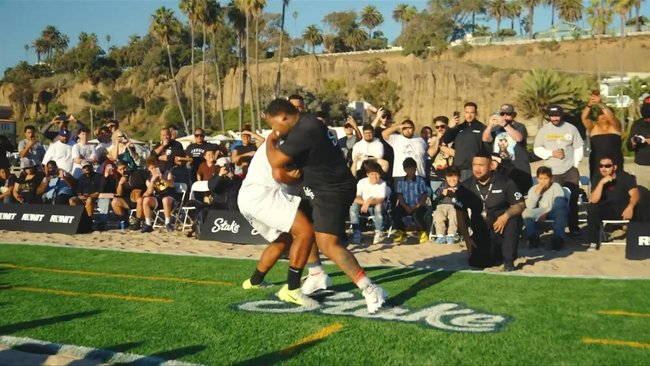
A leading concussion expert has renewed calls to ban the controversial RUNIT Championship after its expansion into a women’s competition ended with a competitor knocked unconscious.
The inaugural female RUNIT Championship match was held in Brisbane over the weekend, marking the latest expansion of the collision-based sport.
WATCH THE VIDEO ABOVE: Controversial run it sport expands to female competitors
Know the news with the 7NEWS app: Download today
RUNIT originated as a schoolyard challenge and sees two competitors sprint directly at each other before colliding in an attempt to overpower their opponent, with knockouts a regular feature of the competition.
In 2025, a group of seven brothers and friends decided to launch a competitive version of the rugby-inspired game they played at school.
The competition has since attracted millions of views on social media and has drawn fierce criticism from concussion experts around the world.
Dr Alan Pearce, a neuroscientist and concussion expert, told Sunrise he was stunned the competition was growing instead of being shut down.
“I can’t believe that we’re talking about this again, and now we’re sort of seeing an expansion into female athletes,” Pearce said.
“Where are they going to go next, junior athletes?”
While organisers say qualified medical staff are present at events and referees enforce a legal tackle zone between the shoulders and waist, Pearce said those measures do little to address the risks posed by the sport itself.
“The big difference in organised sports is that you’ve got an opportunity to evade an opponent. Even combat sports, you can defend yourself,” he said.
“This activity really is about just running straight at each other to collide and create a situation of knocking out the opponent.”

Pearce warned that lowering the point of contact does not eliminate the risk of brain injury, with forces travelling through the body causing the brain to move inside the skull.
“When you have a tissue like the brain, which is like silken tofu, it’s very precious. It doesn’t take that much to actually cause a brain injury,” Pearce said.
The latest controversy comes as major sporting codes continue strengthening concussion protocols and introducing rule changes aimed at reducing head injuries.
Pearce questioned why a sport centred on high-impact collisions was continuing to expand at a time when professional sport was moving in the opposite direction.
“We’re getting progress and good progress in organised sports, but what is the need for someone to actually go ahead and put themselves at such a risk?” he said.
“When there’s an activity like this that is actually exploiting the brain injury component, a lot of us and my colleagues are just scratching our heads.”
Despite growing calls for the competition to be shut down, organisers have signalled they intend to continue expanding the sport.


